
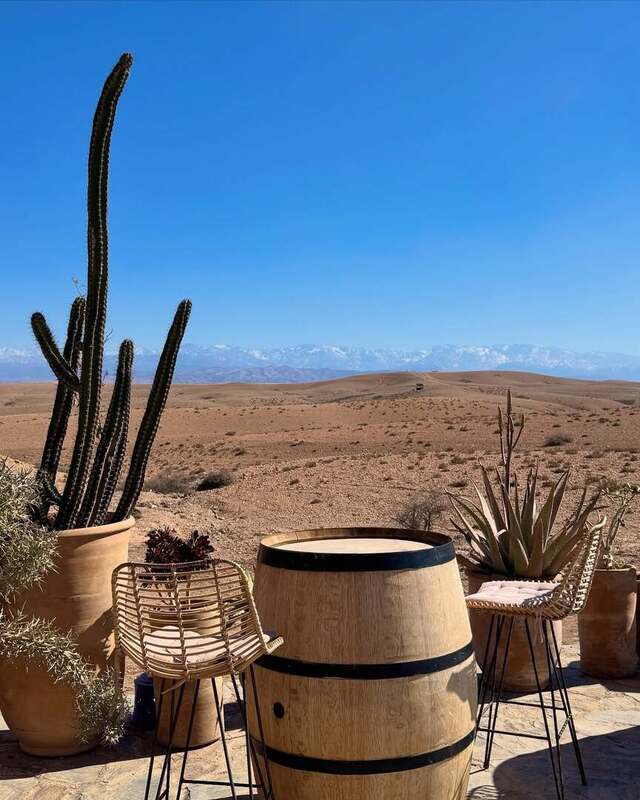
The Agafay Desert is a true playground for photographers. With its lunar landscapes of ochre stones, the majestic silhouette of the snow-capped Atlas in the background and the ever-changing light, every shot tells a story. Whether you're armed with a smartphone or a professional DSLR, this photography guide will help you capture the magic of Agafay like never before.
The best times to photograph Agafay
In landscape photography, light is everything — and in the Agafay Desert, it's spectacular. The golden hour, roughly 30 minutes before and after sunrise and sunset, offers warm, raking light that enhances the desert's relief. Shadows lengthen, textures are revealed, and the ochre tones of the ground literally ignite.
The blue hour, just before sunrise or after sunset, bathes the landscape in striking blue-violet tones. It's the ideal moment for atmospheric photos, especially if you capture the first stars above the Atlas. To learn more about sunset light conditions, check out our guide to sunset at Agafay.
At midday, the light is harsh and contrasts extreme. Avoid portraits at this hour, but take advantage of graphic shots: geometric shadows of bivouacs, stone textures, or minimalist photos playing on contrasts.
Must-visit photography spots in the Agafay Desert
Certain locations in the Agafay Desert are genuine film sets. Here are the spots you shouldn't miss:
Rocky ridges with Atlas views — Climb one of the desert's hills for a 360° panorama with the Atlas Mountains as a backdrop. The depth effect is striking, especially at sunrise when the snowy peaks catch the first rays.
Quad trails — A quad ride through the desert offers dynamic perspectives. The dust trails kicked up by the quads create spectacular backlit effects. Book a quad ride in the Agafay Desert and ask your guide to stop at the best viewpoints.
Camps and bivouacs — Berber tents, lanterns and colourful carpets offer superb contrast with the arid landscape. The luxury camps of Agafay are particularly photogenic.
Olive groves on the desert edge — The transition between the green of the olive trees and the ochre of the desert creates original compositions full of contrast.
Smartphone or camera: what equipment to bring?
Good news: you don't need professional equipment to bring back beautiful images from Agafay. Recent smartphones (iPhone 15/16, Samsung Galaxy S24, Pixel 9) work wonders in landscape and night modes.
With a smartphone: activate HDR mode to manage the strong contrasts of the desert. Use panoramic mode for wide views of the Atlas. Portrait mode works well for details (desert flowers, stone textures, local crafts). Remember to clean your lens regularly — desert dust is persistent.
With a camera: a wide-angle lens (16-35mm) is essential for landscapes. A telephoto lens (70-200mm) lets you compress planes and bring the Atlas closer. Bring a lightweight tripod for night photography and long exposures. Protect your gear from dust with a waterproof bag or UV filter on each lens.
Useful accessories: a polarising filter (reduces reflections and saturates sky colours), a portable battery for your smartphone, and a microfibre cloth for cleaning lenses.
Capturing the Atlas Mountains: composition techniques
The Atlas is the jewel of Agafay's backdrop. To showcase it, apply the rule of thirds: place the ridge line on the upper third of the image. Include a foreground element — a rock, a quad, a camel — to create depth and give the landscape a sense of scale.
Natural leading lines (trails, tracks in the sand, ridge lines) guide the viewer's eye towards the mountains. Look for these lines and compose your image around them. Symmetry also works beautifully with reflections in luxury camp pools, with the Atlas reflecting in the calm water at dawn.
For portraits with the Atlas in the background, use a wide aperture (f/2.8 to f/4) for nice bokeh that keeps the mountains recognisable while highlighting your subject.
Rules for drone use in Morocco
Heads up — sensitive topic! Morocco's drone regulations are strict. In principle, using a drone in Morocco requires prior authorisation from the Directorate General of Civil Aviation (DGAC). Without this authorisation, your drone may be confiscated at customs or during an inspection.
In practice, many travellers use small drones (like DJI Mini, under 250g) in isolated areas such as the Agafay Desert. However, we strongly recommend that you check with local authorities before any flight. Some tourist camps may facilitate the process or allow use under certain conditions. Never fly over military zones, people without their consent, or sensitive sites.
If you do obtain authorisation, aerial views of Agafay are absolutely breathtaking: the geological patterns, ground colours and perspective on the Atlas are incomparable from above.
Capture your quad adventure
The best way to discover Agafay's photo spots? A quad ride through the desert. You'll traverse varied landscapes, from ridges to valleys, with stops at the most photogenic viewpoints. Our guides know the best angles and the best lighting moments. Combine the adventure with a camel ride for different perspectives and unforgettable memories. Book now and bring your best lens!