
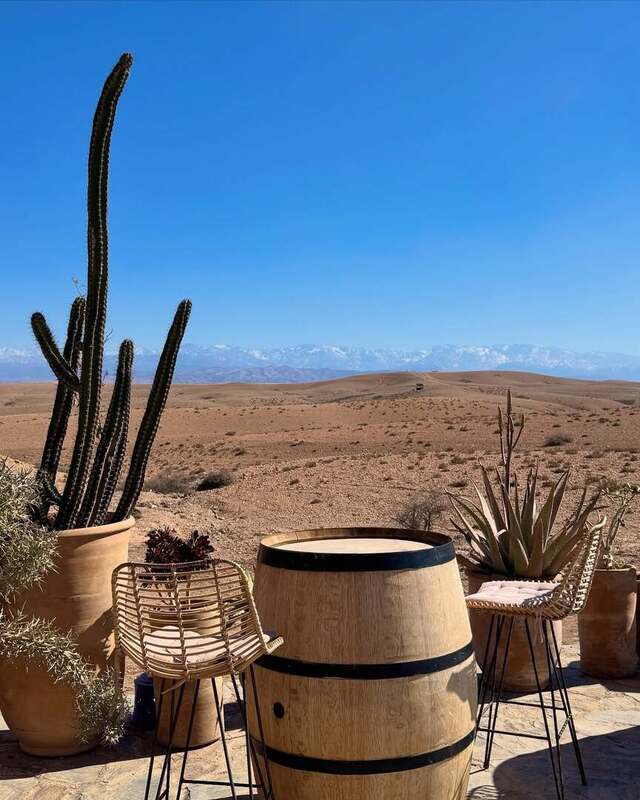
Want to discover the Agafay Desert on foot, at your own pace, taking time to observe every detail of the landscape? Hiking and trekking around Agafay offer total immersion in a breathtaking setting. Berber villages clinging to hillsides, panoramic views of the Atlas, the absolute silence of the desert — here's the complete guide to planning your hike in this unique corner of Morocco.
Why hike in the Agafay Desert?
Hiking in the Agafay Desert is a very different experience from mountain or forest trekking. Here, the landscape is mineral, pared-back, almost abstract. You walk across a rocky plateau strewn with ochre and grey stones, with only the snow-capped peaks of the High Atlas on the horizon. It's a feeling of absolute freedom — no trees blocking the view, no crowds, just you and the immensity of the desert.
The major advantage of Agafay for trekking? Its proximity to Marrakech. Just 30-40 km from the city, you can set off hiking in the morning and be back for dinner. No need to plan a multi-day expedition like for the Sahara. To understand what makes this desert so accessible, check out our guide to tours from Marrakech.
Popular trails and difficulty levels
The plateau loop (easy, 2-3 hrs, ~8 km): This is the ideal route for a first discovery. You cross the heart of the Agafay Desert on wide, well-marked trails. The elevation gain is minimal (less than 150 m) and the terrain presents no technical difficulty. Along the way, you pass panoramic viewpoints over the Atlas and can observe the desert's characteristic rock formations. Accessible to all, including families with children from age 6-7.
The Berber villages trail (moderate, 4-5 hrs, ~14 km): This route connects several small Berber villages nestled in the hills south of the plateau. You follow narrower paths, with moderate ascents and descents, and cross dry riverbeds. It's an opportunity to discover local life: pisé houses, terraced olive fields, goat herds. The inhabitants are welcoming and often offer tea. Cumulative elevation gain: around 350-400 m.
The Atlas foothills trek (difficult, 6-8 hrs, ~20 km): For experienced hikers, this route climbs from the Agafay plateau towards the first foothills of the High Atlas. Technical terrain, significant elevation gain (600-800 m cumulative), narrow passages along ravines. But what a reward: 360° views over the desert on one side and the mountains on the other. Only attempt this with a good fitness level and ideally with a guide.
The wadi circuit (moderate, 3-4 hrs, ~10 km): A route that follows the beds of wadis (dry rivers) flowing down from the Atlas. You walk in natural mini-canyons carved by erosion, with coloured rock walls on each side. It's geologically fascinating — our article on the history and geology of Agafay explains how these formations were created.
What to see along the way: points of interest
Hiking in Agafay holds lovely surprises around every trail bend:
Berber villages: These small pisé hamlets seem to emerge from nowhere, perfectly integrated into the landscape. Traditional architecture uses local earth and stone, creating buildings that literally blend into the scenery.
Atlas panoramas: In clear weather, the view of the High Atlas is spectacular. You can make out Toubkal (4,167 m), the highest peak in North Africa, whose snow often persists until June.
Wildlife: Keep your eyes open! The Agafay Desert is home to hares, foxes, desert hedgehogs, and numerous birds of prey (buzzards, falcons). Early morning or late afternoon offer the best chances of spotting them.
Argan cooperatives: Several women's cooperatives line the trails. It's an opportunity to see how argan oil is extracted by hand and to buy products directly from the producers.
Practical tips: what to bring
Trekking in the desert requires specific preparation:
Water: Minimum 2 to 3 litres per person. There are no potable water sources on the trails. In summer, count on 4 litres instead. This is non-negotiable.
Shoes: High-cut hiking boots with good soles. The terrain is rocky and ankles are exposed. Avoid trainers and especially sandals.
Sun protection: Hat, SPF 50 sunscreen, sunglasses. There is virtually no natural shade in the desert. Our article what to wear in the Agafay Desert details the ideal clothing.
Food: Energy snacks (dried fruit, cereal bars). For longer hikes, bring a packed lunch.
Navigation: A map or GPS is strongly recommended for self-guided hikes. Not all trails are marked.
Guided or self-guided?
For the plateau loop (easy), you can go self-guided if you have a good sense of direction and a GPS. The trails are fairly obvious and the risk of getting lost is limited.
For all other routes, a local guide is highly recommended. Not only do they know the trails by heart (many aren't on maps), but they enrich the experience with their knowledge of history, Berber culture and the area's geology. A good guide will also open village doors and facilitate encounters with locals. Expect around 300-500 MAD (30-50 EUR) for a day's guiding.
The best season for trekking
Spring (March to May) is the prime season for hiking in Agafay. Perfect temperatures (18-26°C), golden light, sometimes a few wildflowers blooming in the wadis. Autumn (September to November) is equally pleasant. Winter (December to February) offers sunny days but cool mornings (5-10°C). Summer is not recommended for long-distance trekking due to extreme heat — if you absolutely must walk, set off before 8 AM. For a detailed weather analysis, check our Agafay weather guide.
Want to combine hiking and thrills? After a morning of trekking, follow up with a quad ride in the Agafay Desert to cover even more ground. Or choose our quad + camel combo for a mixed day of motorised adventure and on-foot discovery. It's the best way to see everything Agafay has to offer!